
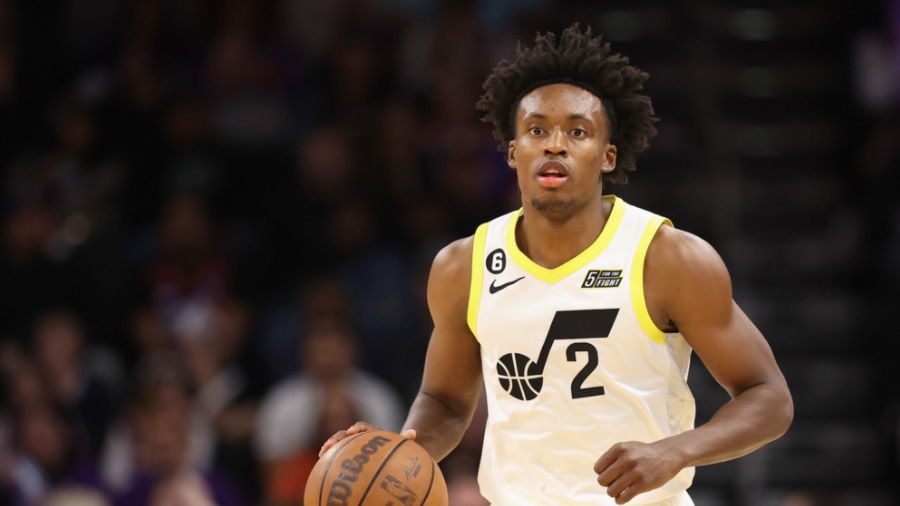
Coming out of the University of Alabama back in 2018, guard Collin Sexton was viewed as an incredibly intriguing and exciting prospect whose athleticism and competitive nature manifested viral highlights, offering an abundance of NBA potential. Sexton was talented enough to be taken early in the first round of the 2018 NBA Draft by the Cleveland Cavaliers, and while he certainly was by no means a true “bust”, the Cavs were willing to move him ahead of the 2022-23 season to acquire Donovan Mitchell from the Jazz. The young guard was originally perceived as the centerpiece heading to Utah and would serve as a foundation for the ensuing rebuild. While a Lauri Markkanen breakout has extinguished that concept, Sexton’s 2022-23 campaign presented more questions than answers about what Sexton’s role with the Jazz would be moving forward. Much of his struggle could be attributed to injuries, as he only played in 48 games, but his style of play, or more specifically his lack of shooting ability (2.5 3PA/g last season), contorted with the schematic makeup of Will Hardy’s offense in addition to some questionable decision-making on both sides of the ball would limit his impact in his first year with the Jazz.
This season offered an opportunity for Sexton to dismiss many of these questions and emerge as a key player for the Jazz given his rejuvenated health and familiarity with the coaching staff. I personally believed his play would be incredibly impactful for the Jazz going into the season, and whether it landed on the positive or negative end of the spectrum would determine how Utah would progress in reconstructing this roster. Cumulatively, his stats through the first 29 games of the 2023-24 campaign are not overly impressive or dissimilar to last season, but narrowing in on the most recent 7-game stretch for the Jazz eludes to Sexton’s breakout potential.
He’s averaged 23.9 pts/g on 48.3/38.5/90.5 shooting splits with high volume, 5.6 3PA/g, over the last 7 games. Prior to last night’s matchup with the Pistons where he only scored 19 points, Sexton had recorded 20+ points in six straight games. The scoring eruption commenced amidst an onslaught of Jazz injuries, including an extended stretch without Lauri Markkanen and a handful without Keyonte George, yet Sexton was able to lead the charge across a tough stretch of games for the Jazz and sustain a 4-3 record collectively. Coach Will Hardy has gone on record discussing how he has openly challenged Sexton to improve his decision making and ultimately capitalize on his elite ability to pressure the rim. After the December 18th win over the Brooklyn Nets, Hardy commented on Sexton’s recent improvements, “He’s showing real growth in terms of the technical part of the game and the reads that he’s making with the ball.”
In essence, Collin Sexton’s outbreak is a product of two notable developments aside from simply making better reads: a more sound understanding of moving the ball in the halfcourt, and an increased willingness to shoot outside shots.
A major criticism of Sexton’s game throughout his career has regarded his shot profile consisting of too many pull-up jumpers in the midrange area. While this does relate to the notion of him being a poor 3-point shooter, it also represents a grotesque tendency to settle for bad shots. Given his speed, Sexton is naturally inclined to pressure the rim and blow by his defender. NBA defenses adjusted early on and would clog the paint to fend off Sexton’s drives and leave him stuck in the mid-range area. Here’s an example from 2019 while playing for Cleveland:
Sexton does a pretty good job setting up his defender for the screen, but the screener’s defender sits in a deep drop coverage to deny any further movement towards the rim. Instead of maintaining his dribble or swinging a pass to a teammate, Sexton settles for a long mid-range shot that he misses. Albeit, there was less than 6 seconds on the shot clock, but NBA defenders will gladly accept long mid-ranges all day. Now let’s fast forward to a matchup from December 16th against the Sacramento Kings:
Sexton rips straight into a drive late in the shot clock and when he sees Keon Ellis cut him off, he adjusts rather than settles for a lesser shot attempt. A quick between-the-legs move opens up a bit more space and gets Collin to the free-throw line. Despite limited time on the shot clock, Sexton’s maturity shines through which is why he does not panic upon his initial move being denied and manifests himself an easier shot (which turns into free-throws). This is a great example of how Sexton can best utilize his burst in spite of his questionable shooting numbers.
An essential component of this Jazz offensive scheme is shooting a high volume of three-pointers, and team success is reliant on making a high percentage of such shots. Sexton’s past unwillingness to shoot a substantial amount of three-pointers created some unruly hesitation to keep him on the floor in impactful minutes for the Jazz. Sexton’s 3P% has improved steadily over his career, however it has been difficult to truly assess whether the improvements are legitimate as his volume has remained relatively low. As I mentioned previously, Sexton has attempted over 5 three-pointers a game over this 7-game streak and has converted nearly 39% of them.
The purpose of the Jazz offense is to sustain individual player movement and keep the ball moving to create easier shot attempts. Sexton has seemed to buy into this sense of movement, which has enabled him to witness more looks from beyond the arc. There’s an increased confidence level in his outside shooting ability, both from within himself and the Jazz’s coaching staff. This naturally leads to Sexton attempting more threes, henceforth bludgeoning his scoring average. If Sexton’s newfound confidence in his shot and increased willingness to shoot the ball from deep sustains, this hot streak may convert to normalcy for the talented guard.
Only time will tell if Sexton’s play is truly viable for the near-future. Nonetheless there is surely an influx of satisfaction for both the Jazz coaching staff and fanbase to see noticeable development for a player who’s performance will significantly influence the direction of the organization. There have been lingering rumors on whether or not Sexton may be traded if not by this upcoming deadline than perhaps in the offseason. Even if the considerable production and efficiency fall off slightly for Sexton, the processing improvements are evident, which may rationalize his fortification as a long-term member of the guard rotation in the midst of Utah’s reconstructive phase.

 West Coast Hoops